Current research interests
- Ultrafast intense laser-matter interaction and Attosecond Physics (in particular tunneling ionization, high-order harmonic generation, above-threshold ionization, and dynamic chemical imaging of molecular structure). You can also get some idea of my work by taking a look at my recent publications and my Google Scholar.
Previous interests
- General three-body collisions theory (in particular charge-transfer processes in ion-atom, positron-atom collisions).
- Non-relativistic and relativistic atoms in external fields.
- Strongly-correlated electron systems.
Some research highlights
Highly accurate semiclassical method for strong-field physics
We have successfully developed a powerful method, the strong-field Herman-Kluk propagator (SFHK), for highly accurate treatment of atoms and molecules in ultrafast intense lasers. In terms of accuracy, the SFHK represents the state-of-the-art method currently available for rescattering phenomena in strong-field physics. The figure below compare typical SFHK results with exact numerical solutions of the time-dependent Schrodinger equation (TDSE) for photoelectron momentum distribution (PMD, left panel, for H and Ar) and high-harmonic generation (HHG) spectrum and phase (right panel, for H atom).
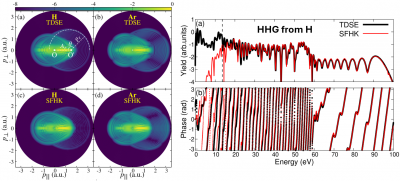
In the SFHK, we use the strong-field approximation only for the ionization step. Once the electron is ionized, we then employ the semiclassical Herman-Kluk propagator to propagate the continuum electron wavefunction (i.e., the wave-packet) immediately from its “born” time at the tunnel exit. By using the Herman-Kluk propagator, we can easily include the full electron-target ion interaction together with the electron-laser interaction. That is the main reason for the high accuracy of the SFHK method. Within the SFHK, the main computational task is to solve classical Hamilton’s equations for independent trajectories in the phase space, each of which represents the motion of the center of a coherent state. Since the trajectories are independent, they can be very efficiently calculated with primitive parallelization on multiple cores. The method also scales nicely with the number of atoms in the molecule. Our method was first described in this paper for PMD (also see this paper), and this paper for HHG. The extension to molecules was described in this paper for HHG.
Ultrafast imaging of molecular structure
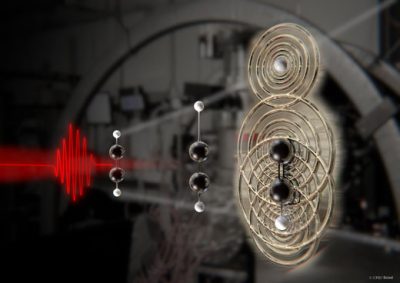
We imaged extremely fast breaking up of acetylene molecule in real time! The snapshot was recorded 9 femtoseconds (one femtosecond is 1/1,000,000,000,000,000 of a second) after the breakup was initiated, by the Laser-Induced Electron Diffraction (LIED) technique. Experiments were performed in the group of Prof. Jens Biegert at the ICFO. See an artist’s rendition (on the right) of the imaging process (courtesy of ICFO – The Institute of Photonic Sciences, Barcelona and Scixel.) For more detail, see our paper in Science, as well as Science Perspective and press release.
 Universality of returning electron wave packet in high harmonic generation
We showed that a returning electron wave packet in high harmonic generation with mid-infrared lasers converges to a universal shape for laser wavelengths above about 3 µm. See illustration on the right for the scaled wave packet from hydrogen in intense laser field of different wavelengths from 1.2 µm to 3.2 µm. Quantum “orbits” multiple returns and HHG wavelength scaling law can also be studied within this approach. For more detail, see our paper in Phys. Rev. Lett.
We made the rescattering theory quantitative
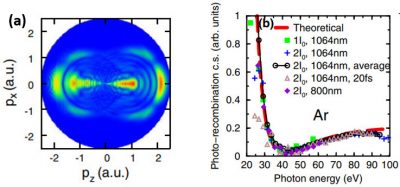
We developed the Quantitative Rescattering theory (QRS), which revealed the connection between various extremely nonlinear phenomena in strong-field physics with traditional scattering physics. This theory provides a solid theoretical foundation for novel ultrafast molecular structure imaging techniques such as the laser-induced electron diffraction (LIED) and high harmonic generation spectroscopy (HHS) — see illustration below. For more detail, see our paper in Phys. Rev. Lett. and further development for HHG and high-energy momentum spectra.